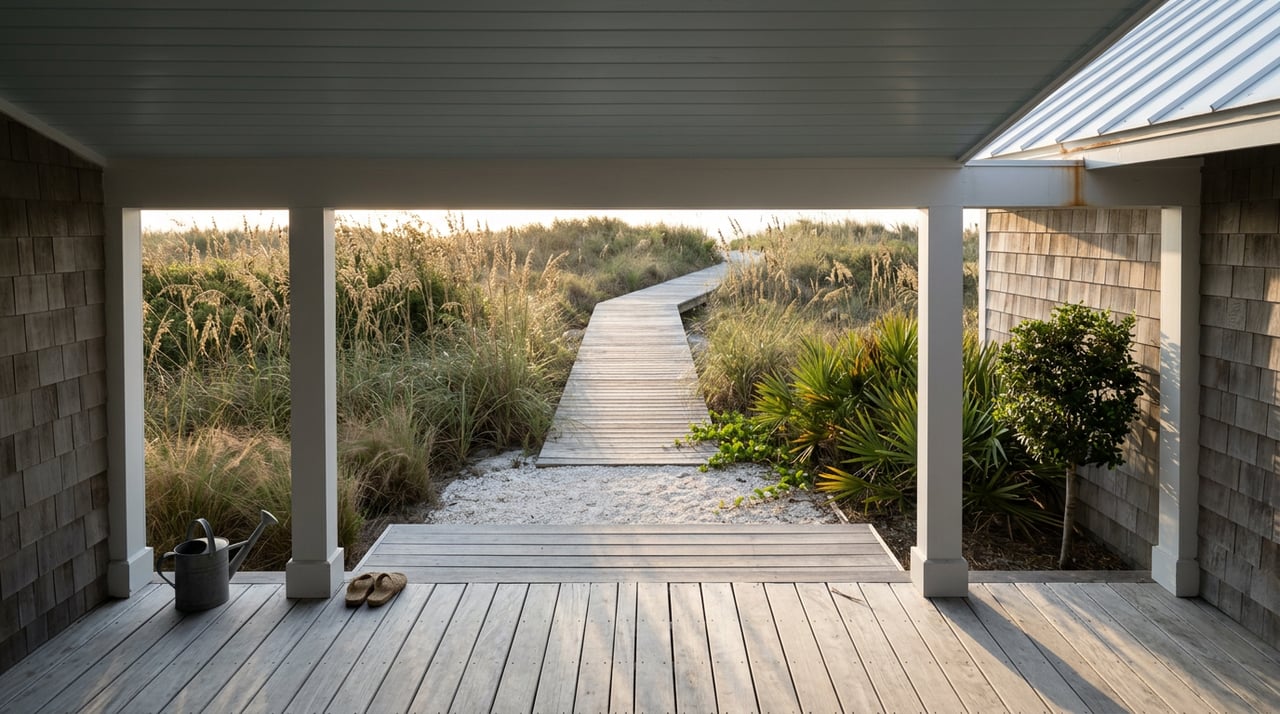
A buyer flying in for a weekend of showings can see three homes with "Watersound" in the address, all within a few miles, and walk away thinking they understand the market. They don't yet. The gap between a home in Watersound Origins and a home in Watersound Beach isn't just square footage or Gulf proximity. It's a private membership program that lives outside the deed, and it determines whether your address actually delivers the lifestyle in the brochure.
That is the friction most out-of-state buyers meet only after the inspection period, and it's the piece of the story the portals cannot show you.
Four communities, one brand name
"Watersound" is a St. Joe Company umbrella. Four distinct communities sit under it, each with its own rules, price tier, and daily rhythm.
- Watersound Beach — the gated, south-of-30A original, roughly 256 acres with about a mile of Gulf frontage and a plan for around 511 units, anchored by the private Watersound Beach Club.
- Watersound West Beach — smaller, adjacent, marketed heavily for rentals with its own association rules.
- Watersound Origins — the inland, north-of-98 master plan built around Origins Golf Course, Village Commons, and the Watersound Town Center with a Publix at the entrance.
- Watersound Camp Creek — the newer gated custom-home enclave beside Camp Creek Golf Club, at the top end of the pricing scale.
They share a developer and a name. They do not share amenities, HOA structure, insurance exposure, or short-term rental posture. Assume otherwise and you will overpay for a right you don't actually have, or underprice a rental you were counting on to work harder.
The mechanism: the club is not the deed
Here is the piece that catches nearly every remote buyer off guard. Watersound Club, which operates the private Beach Club, the Camp Creek Club, and the golf offerings, is a hospitality program run separately from any HOA. Buying a home inside Watersound Beach does not automatically transfer club membership. The two transactions run on parallel tracks.
In Origins, the arithmetic looks different again. Owners are auto-enrolled in an Origins-level membership that is bundled into the HOA assessment and covers Village Commons, the resort-style pool, trails, tennis, pickleball, the short-course golf layout, and the Lake Powell dock. Access to the Beach Club or Camp Creek Club is a separate upgrade, subject to availability, application, and additional dues. That upgrade is where the real money enters the conversation. Reported figures from active 30A market write-ups put initiation for a full St. Joe Club membership around $75,000, with monthly dues starting near $1,200. Confirm current numbers directly with the club before you plan around them, because the tiers and terms shift.
The address gets you the house. The membership, purchased separately and priced independently, gets you the private boardwalk, the zero-entry pools, the beach chair service, and the dinner reservation on a Saturday in July.
Skip that clarification and the "Watersound premium" a buyer thought they were paying for evaporates on the first weekend they try to walk onto the sand.
What the portal number actually buys
Once you separate the deed from the club, the price bands begin to make sense.
Origins is the entry point. New construction and villa product at Villas on the Fairway have been quoted starting around $495,000 for three-bedroom, two-and-a-half-bath plans, with the broader community running from the mid-$500s into the multi-millions for custom homesites. That price reflects an inland location, favorable insurance exposure, HOA-bundled amenities, and a rental posture that in many sub-phases prohibits short-term rentals. You are buying a full-time or second-home neighborhood, not a rental machine.
Watersound Beach sits at a different tier. Public market coverage of the gated south-of-30A community places typical transactions in the $2 million to $10 million-plus range, with base annual HOA closer to $4,940 and property taxes on a $4 million home reasonably estimated between $36,000 and $44,000. Add the optional St. Joe Club membership and the annual carry lands in the high $40,000s to mid-$50,000s, before the $75,000 initiation. Short-term rentals are allowed subject to Walton County's permitting process, which means the community can double as an income asset, though sub-associations such as Watersound West Beach publish their own renter rules, fines, and restrictions on items like golf carts.
Camp Creek is a separate conversation. Recent trailing-twelve-month median sale figures reported by third-party market pages have run near $4.2 million, and public listings for the neighborhood commonly note that short-term rentals are not permitted. The buyer profile is a full-time or true second-home owner who wants golf, privacy, and club alignment, not a nightly rate.
Three price tiers, three carrying-cost profiles, three rental postures. Same brand on the sign at the entrance.
Rental posture quietly re-prices the whole decision
For buyers who plan to offset carry with rental income, the underwriting has to happen at the sub-neighborhood level, not the Watersound level.
Watersound Beach and West Beach have active vacation-rental markets. That is a real cash-flow lever, and it is also why the operating budget looks nothing like the one you would build for Origins. Cleaning turns, management fees, permitting, association rules on guest occupancy, and stricter enforcement in places like West Beach all belong in the pro forma. Ask any seller for twelve to twenty-four months of booking and operating history before you assign a cap rate to the deal.
Origins runs the opposite way. Many sub-phases restrict or prohibit short-term rentals as a matter of community design. That protects the resident-forward feel that drew buyers there in the first place, and it also means the property has to pencil as a primary or second home. Buy Origins expecting rental income and you have bought the wrong community.
Camp Creek generally lines up with Origins on the rental question and with Watersound Beach on the price tier. The one authority that matters here is the recorded CC&Rs for the specific parcel. Public listings and marketing pages are useful signals. They are not binding.
Questions worth answering before you write an offer
The five items below are the ones that most often surface late in a Watersound transaction. Handle them early and the negotiation gets calmer.
- Which specific Watersound community, and which sub-association within it, governs the parcel?
- Does the seller hold a current Watersound Club membership, and if so, at what tier and under what transfer terms?
- What does the recorded CC&R actually say about short-term rentals, minimum lease lengths, and guest occupancy?
- What are the total quarterly HOA charges, and what do they include versus what is billed separately by the club?
- What is the current Walton County short-term rental permit status on the property, and are there any open code cases?
Each of those questions has an answer that lives in a document, not a marketing page. Getting them on paper before diligence closes is how you avoid the common outcome of a buyer paying the Watersound Beach price for what turns out to be an unfurnished house without club privileges.
Frequently asked questions
Does buying in Watersound Beach guarantee Beach Club access?
No. Watersound Club is a private hospitality program administered separately from the HOA. Ownership does not automatically convey membership, and membership terms, fees, and availability can change. Confirm current tiers and dues with Watersound Club directly.
Can I rent my Watersound Origins home on Airbnb or VRBO?
In many Origins sub-phases, no. The community is designed around full-time and second-home use, and short-term rentals are commonly restricted at the sub-association level. Verify by reading the recorded CC&Rs for the specific home before you assume income.
What is the practical difference between Watersound Beach and Watersound Camp Creek?
Watersound Beach is a gated, dune-and-boardwalk coastal community south of 30A with about a mile of Gulf frontage. Camp Creek is a newer gated custom-home neighborhood beside Camp Creek Golf Club, with larger homesites, higher price points, and rental restrictions that keep it resident-focused.
Are Watersound property taxes and insurance higher than in Origins?
Coastal exposure and elevation drive both numbers. Homes closer to the Gulf generally carry higher wind and flood premiums than inland Origins parcels. Get an insurance quote early in diligence rather than at the end. It can shift a monthly carry by a meaningful amount.
Is the Watersound Club initiation refundable or transferable?
Terms are set by Watersound Club and vary by membership tier. Some tiers include transfer provisions, others do not. This is a document review, not a rumor review. Ask for the current membership plan in writing.
A calmer way to buy in Watersound
Most of the pain in a Watersound purchase comes from treating the four communities as one and treating the club as a given. The buyers who close cleanly are the ones who read the CC&Rs, confirm membership terms in writing, and price the carry with real Walton County insurance quotes and operating history in hand.
If you are weighing Watersound Beach against Origins, Camp Creek, or a neighboring 30A community, and you want a candid read on what the number actually buys, La Florida Coastal Properties is a good next call. Let's talk.