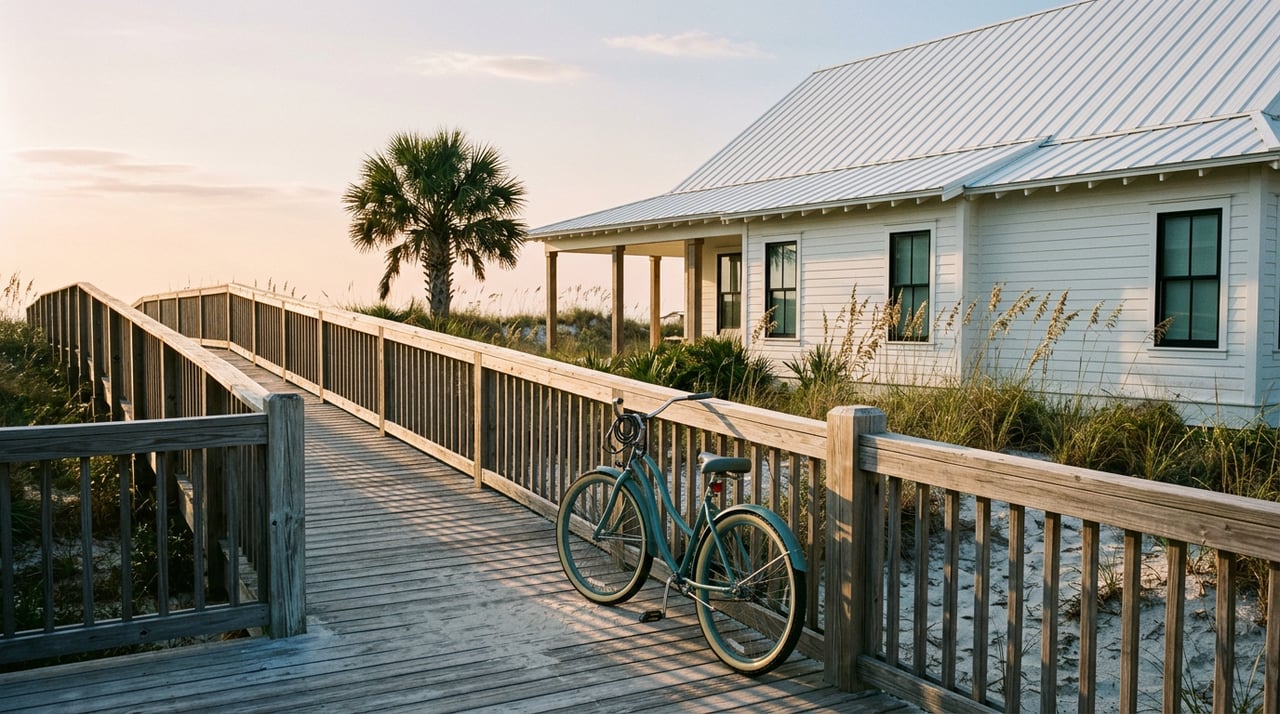
Walk through the tunnel under Highway 98 in Inlet Beach today and you'll pass ten murals, two sculptures replicated from the Underwater Museum of Art, and, if it's a weekday evening, a handful of bikes leaning against the walls near the south exit. That last detail is the one worth paying attention to. Not the art. The bikes.
For roughly sixteen months after the underpass opened, that scene was uncommon. The $5.6 million project, a decade in the making, initially drew less pedestrian and bike traffic than expected.
A Decade of Near-Misses Bought This Tunnel
The push for a safe crossing at Highway 98 and Scenic 30A started long before construction did. According to Leigh Moore, executive director of Scenic Walton, the idea gained urgency when the Donut Hole opened on the north side of the highway and foot traffic started crossing four lanes in volumes the road was never built to handle. Business owners including Brian Corr of the Corr Group, which developed 30Avenue, John Freer, and Brent Chandler of the Donut Hole told Moore they were watching people nearly get hit at that intersection on a regular basis.
That's what turned a decade of planning meetings into an actual construction budget. The Florida Department of Transportation put $5.6 million into the project. Scenic Walton, Walton County officials, and the Walton County Tourism Department worked alongside the Cultural Arts Alliance of Walton County, which commissioned ten local artists to fill the tunnel's 136-foot length with original murals on the theme of connectivity: Francisco Adaro, Katherine Boggs, Heather Clements, Bradley Copeland, Olga Guy, Wes Hinds, Sarah Page, Andy Saczynski, Andrea Scurto, and Lindsay Tobias. At each end, replica sculptures from the Underwater Museum of Art mark the entrances: "The Grayt Pineapple" by Rachel Herring McCord on the north side, "Common Chord" by Vince Tatum on the south.
The underpass opened to the public over Labor Day weekend 2024, connecting the neighborhoods north of Highway 98 to the beach, to 30Avenue's restaurants and shops, and to the entrance of Rosemary Beach. On paper, it solved the safety problem and gave the east end of 30A a genuine pedestrian link for the first time.
The Underpass Took Time to Find Its Users
The low usage persisted into the second winter.
By January 2026, county officials were saying out loud what residents on both sides of the highway already suspected. The underpass wasn't drawing the foot and bike traffic anyone expected. Moore told a local news crew the reason was almost embarrassingly simple: people visiting the area didn't know it was there.
As WJHG reported, "The thing that excited us the most, we're all about scenic beauty, but this is a life saver."
That quote captures the gap between what the tunnel was designed to be and how it was being used by its second winter. A safety feature and an art installation, it was still seeing little traffic because visitors didn't know it was there.
Walton County commissioners approved funding in November 2025 to address the low usage. The plan was straightforward: new signage at both ends and changes to the surrounding pathways to guide pedestrians and cyclists toward the underpass. County engineers set a deadline to finish the work before spring break 2026, betting that the busiest season of the year was the moment that mattered most for changing habits.
What Changed by Spring, and How You'd Know
Spring break came and went, and unlike a lot of infrastructure fixes, this one produced a measurable shift by summer. Not in a traffic study or a county report, but in a much smaller, more telling place: the front door of the businesses at 30Avenue.
By August 2026, Corr was describing a different tunnel than the one Moore had been troubleshooting seven months earlier. "We are seeing more pedestrian and bike traffic since the underpass opened," he told Scenic America, which profiled the project as an example of infrastructure reshaping how a community actually moves. Visitors, he said, were beginning to discover the safer option of crossing the highway on foot instead of driving between destinations a few hundred feet apart.
The proof wasn't a number Corr pulled from a sensor. It was an operational headache. Tenants at 30Avenue started asking for more bike parking because bikes were piling up outside their front doors faster than the existing racks could hold them. That's not the kind of detail a press release invents. It's the kind of friction that shows up only after behavior has actually changed, when a shopping center built around car parking suddenly has too many bikes and not enough places to lock them.
What This Actually Means If You Live North of 98
If you've lived on the north side of Highway 98 in Inlet Beach for more than two years, you remember what getting to the beach used to require. Load the bikes in the car, drive across, find parking again on the other side, unload. The distance was never the problem. The highway was.
That calculation has quietly changed. A family north of 98 can now walk under the highway, emerge near the green at 30Avenue, grab dinner, and continue on foot to Rosemary Beach for an evening without touching a car key. The tunnel doesn't erase the highway. It removes the reason to drive across it for a trip that used to take ten minutes each way.
That shift matters more than the murals do, even though the murals are what most visitors photograph first. Ten local artists gave the tunnel its personality. What gives it its function is the pedestrian and bike traffic it now carries, following the county's signage and pathway changes. Sixteen months of underuse followed by a bike parking shortage isn't a tidy launch story. It tells you something about how infrastructure in a growing beach town actually gets adopted: slowly, unevenly, and as the signage and the habits catch up to the concrete.
For anyone weighing how connected the east end of 30A really is day to day, that's the detail worth knowing. Not just that a tunnel exists, but that its use has grown, and that tenants at 30Avenue are now asking for more bike parking.
If you're curious how changes like this ripple through property values, rental demand, or day to day life on the east end of 30A, Andre Dominick and Theresa Felton follow this corridor closely and are happy to talk through what it means for your particular stretch of Inlet Beach. Let's Talk.