Scroll through Rosemary Beach listings long enough and you'll notice the same phrase surfacing on the higher-end compounds: a main house paired with "a private carriage house," pitched as flexibility, privacy, and rental upside rolled into one line. One recent listing built by architect George Israel describes a four-bedroom main residence completed in 2002 with a two-bedroom carriage house added in 2007, calling the pairing "a rare opportunity offering flexibility, privacy, and exceptional investment potential." Another, on an oversized corner lot on East Kingston Road, pairs a five-bedroom estate with its own carriage house and room for fourteen guests.
What the listing copy doesn't spell out is that the carriage house isn't a bonus room. It's a distinct structure with its own approval process, its own fee schedule, and its own rental rules layered on top of the ones that already apply to the main house. Two Rosemary Beach properties can carry the same asking price and sit on nearly identical lots, and still represent very different ownership costs depending on whether that second structure is a converted garage apartment someone is renting off the books or a fully permitted, HOA-registered unit built to code.
Why the median price hides this
Rosemary Beach's own housing data makes the point better than a summary could. As of June 2026, the town had 45 houses listed, ranging from $649,900 to $9,650,000, with a median price near $1,775,000 against an average sale price of $2,263,388, a gap of nearly half a million dollars between the two measures.
Neither number is wrong. They're measuring different mixes of product. A studio flat above a Town Center shop and a five-bedroom courtyard estate with a detached carriage house both count as "Rosemary Beach real estate," and a single median blends them into a figure that describes neither. The carriage house is one of the biggest reasons that gap between median and average exists. It's the difference between a compact cottage on a standard lot and a compound that functions almost like two homes on one deed, and it moves the math for anyone comparing listings by price per square foot alone.
The carriage house is a building type, not an add-on
Rosemary Beach was platted in 1995 as one of the early Traditional Neighborhood Developments on 30A, designed by Duany Plater-Zyberk, the same firm behind Seaside's master plan. The town's design code doesn't leave architecture to individual builders. It defines twelve specific building types, and the carriage house is one of them: officially, a detached accessory dwelling positioned above a garage.
That distinction matters because it means a carriage house isn't something an owner can informally build in the backyard. It has to conform to a predefined lot type, sit within specific setback rules, and clear the same Architectural Review Board that governs every other structure in town. Recent MLS listings describing carriage houses this way aren't using the term loosely. A courtyard residence on Bridgetown Avenue designed by architect Tim McNamara and a compound on Atwoods Court renovated by Heather Rowland Interiors both use "carriage house" to describe a specific, code-recognized structure, not a marketing flourish.
What adding or renovating one actually costs
This is where the friction shows up for buyers who assume a carriage house is simply extra square footage they're getting for free. Anyone building a new carriage house or substantially renovating an existing one is signing up for a defined cost stack before construction even starts.
| Cost item | Typical range |
|---|---|
| One-time capital contribution fee (new construction or major renovation) | $5,000 to $25,000 |
| ARB fee for minor changes (paint, doors, window boxes) | $500 to $1,500 |
| ARB fee for major renovations requiring engineered drawings | $15,000 to $35,000 |
| RBPOA dues, detached single-family | $1,592 per quarter ($6,368 per year) |
| RBPOA dues, condo | $5,144 per quarter ($20,576 per year) |
| Transfer fee at closing | 1% of purchase price |
The Architectural Review Board meets monthly, and it commonly asks for revisions, which can push a straightforward project out by 60 to 90 days. Even minor cosmetic work needs drawings from a licensed design professional before the board will look at it. None of this is unusual for a design-controlled community, but it's a real timeline and a real invoice that a buyer comparing Rosemary Beach to a less restricted 30A neighborhood needs to price in before assuming the carriage house is pure upside.
Once the numbers are layered together, a property in the $1.5 million to $2.5 million range typically carries $31,800 to $59,600 a year in costs beyond the mortgage, a figure that includes HOA dues, layered wind and flood coverage, and maintenance reserves for wood-frame construction a few hundred yards from salt water. A carriage house doesn't replace any of that. It adds its own slice on top.
Renting it out has a separate rulebook
The other assumption worth checking before closing is that a carriage house can simply be listed on a booking platform the day the deed transfers. It can, but only within Rosemary Beach's rental structure, which applies regardless of whether the unit is a spare bedroom or a fully separate address.
Minimum stay requirements typically run seven nights during peak summer season and three to five nights in the off-season, though specific deed restrictions vary by property. Occupancy caps are enforced by bedroom count and square footage, and violations carry fines of $500 to $1,000 per incident. The Rosemary Beach Property Owners Association can suspend rental privileges entirely for repeat violations, which means an owner counting on carriage house income to help cover carrying costs can lose that income stream if the property manager or a guest doesn't follow the rules.
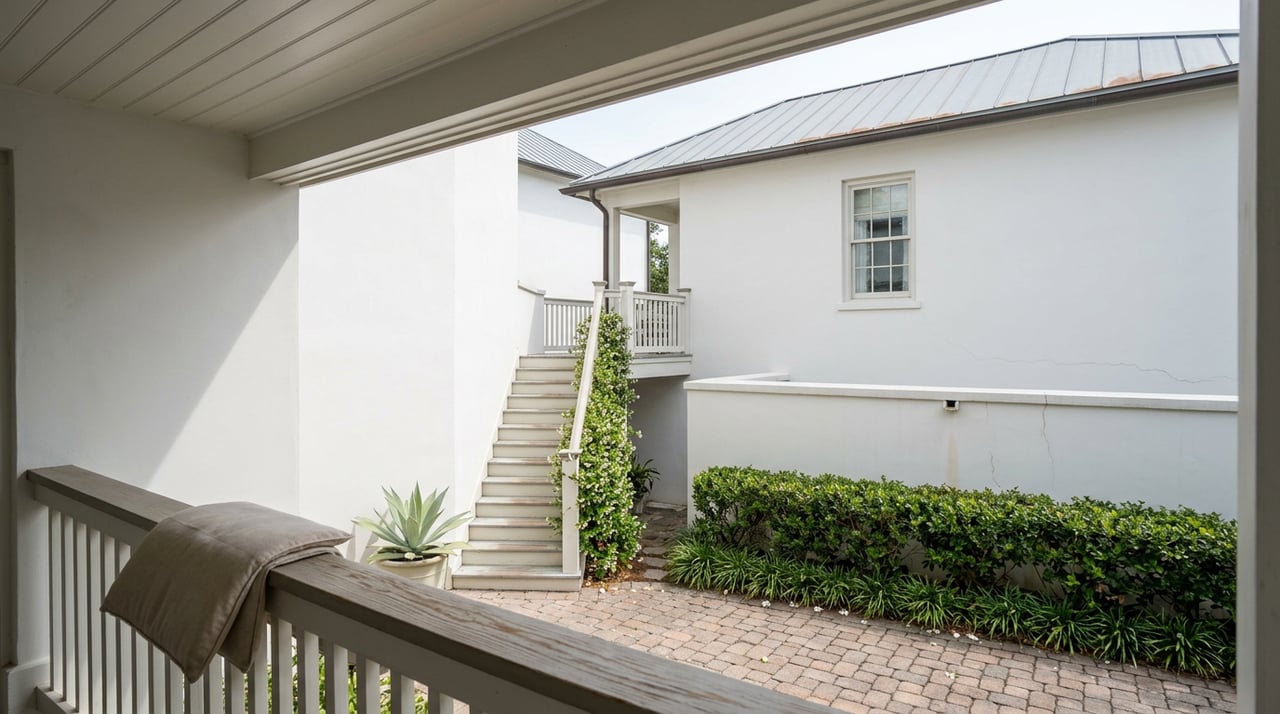
The Carriage House model, a detached accessory dwelling above a garage, is one of twelve predefined building types that keep Rosemary Beach's streetscape consistent from block to block.
That consistency is the trade a buyer is making. The same architectural review process that adds cost and time is what keeps a carriage house from turning into a mismatched addition next door. For a buyer weighing Rosemary Beach against a 30A community with fewer design controls, that's the actual comparison: predictable character and a slower, costlier approval path, against faster renovation timelines and less certainty about what gets built around you.
Reading a listing with two structures on it
None of this means a carriage house is a liability. Recent listings on Atwoods Court and East Kingston Road market these compounds specifically because a permitted, well-run carriage house can generate real rental income while giving owners a private guest suite or multigenerational living space the rest of the year. The point is that the value only shows up on paper if the structure is properly licensed, registered, and compliant with both county short-term rental rules and RBPOA policy.
Before writing an offer on a compound-style property, it's worth asking a few direct questions: Is the carriage house currently registered as a short-term rental, and does that registration transfer to a new owner or need to be reapplied for. Has it passed its most recent ARB review, or is there deferred maintenance that will trigger a new submittal. And what has it actually earned in the last twelve months, not what a listing estimates it could earn. Those answers change the real cost of ownership more than the headline price does.
Frequently asked questions
Does a carriage house count toward the home's total bedroom count for occupancy limits? Occupancy caps in Rosemary Beach are enforced based on bedrooms and square footage, and specific deed restrictions vary by property, so this should be confirmed in writing with the RBPOA before assuming a combined occupancy figure.
Can a buyer convert an existing garage into a carriage house after closing? Any new construction has to conform to Rosemary Beach's predefined lot and building type requirements and clear Architectural Review Board approval, which means a garage conversion is treated as new construction subject to the same capital contribution fee and design review as building one from scratch.
Is the RBPOA transfer fee negotiable between buyer and seller? The 1% transfer fee is a community assessment collected at closing rather than a negotiable brokerage cost, so it should be built into offer math the same way transfer taxes are, and confirmed against the current RBPOA fee schedule during due diligence.
A carriage house can be one of the smartest features on a Rosemary Beach lot or one of the most expensive surprises, and the difference usually comes down to paperwork nobody read closely before closing. If you're comparing compound-style listings and want a clear read on what a specific carriage house actually costs to own and what it's actually earned, Andre Dominick and Theresa Felton at Coastal 30A Properties can walk through the HOA statement, the ARB history, and the rental registration with you before you write an offer. Let's Talk.
This article is general information, not legal, tax or financial advice. Consult a qualified professional about your situation.